Mountain Bike Perform crazy stunts in this downhill mountain bike racer! |
| Play this free game now!! |
Do you want to be rich? Just click the link below
Saturday, October 13, 2007
Saturday, June 9, 2007
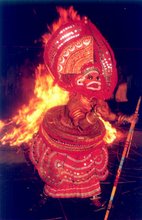
thayyam moving art

Moving Art Raghavan Payyanad
“Art cannot be retained as art alone. It is inherently related to the changing scenario of human life, be it political, social or temporal,” Raghavan Payyanad, director of the Centre for Folklore Studies of University of Calicut, did not seem much perturbed about the decline of traditional art forms. He, in fact, feels it is inevitable.A scholar in folklore and traditional arts of Kerala, Raghavan is the head of the only university department in the state dedicated to folklore studies.He was in the city on Tuesday to interact with the youth attending the Kerala Youth Forum 2007.Raghavan, who did his doctoral thesis on theyyam and thottampattu, has also authored books on theyyam and other folklore of Kerala.“Any art form needs innovation for enrichment,” he says. “It is difficult to evolve an art form if you are no longer able to relate to it with your milieu. Art needs a context to evolve.”Raghavan believes that if art does not evolve with the changing times, it becomes difficult to sustain it. “That is what has happened to most of our traditional art forms. They all died because they became static. Only a few of them like theyyam have managed to stay afloat. And that is largely owing to its visual splendour.”Theyyam is more of an experience rather than an aesthetic enjoyment. It is an intense experience which you cannot actually take for more than a few minutes. But nowadays, theyyam is being projected as a visual treat rather than a religious ritual.The attribution of religious significance to the art form is also to be blamed. “As part of saffronisation, all the sacred groves in north Kerala have been converted into temples with the installation of permanent deities. Theyyam has thus become an integral part of the rituals at these temples. In that way, the temples have sort of monopolised this tribal art form,” he says.According to him, most of the recent trends in preserving traditional art forms are actually a pretext for exploiting them and thus making them a commodity. He notes that the plight of folk arts is more or less the same in most parts of the world, including the West.“There was a move in America recently to close down the folklore department of University of Pennsylvania, the oldest folklore department in the world, as it was not profitable. What the government wants is to start a new discipline called Public Folklore, which is actually a glorified term for commodification of the folklore for public amusement.”“Traditional art forms may no longer be significant in the current scenario. That is understandable. But what is not acceptable is the double standards the authorities show in the name of preserving them,” Raghavan says.
Subscribe to:
Posts (Atom)